
Sub-Saharan Africa has both densely populated cities and vast rural areas where families live far apart. Even in towns, piped networks don’t reach every neighborhood or run reliably. In many rural areas there’s no piping at all. Where there’s no nearby source of clean drinking water, people walk long distances every day. That time burden often falls on girls, who miss school to fetch water instead of getting an education.
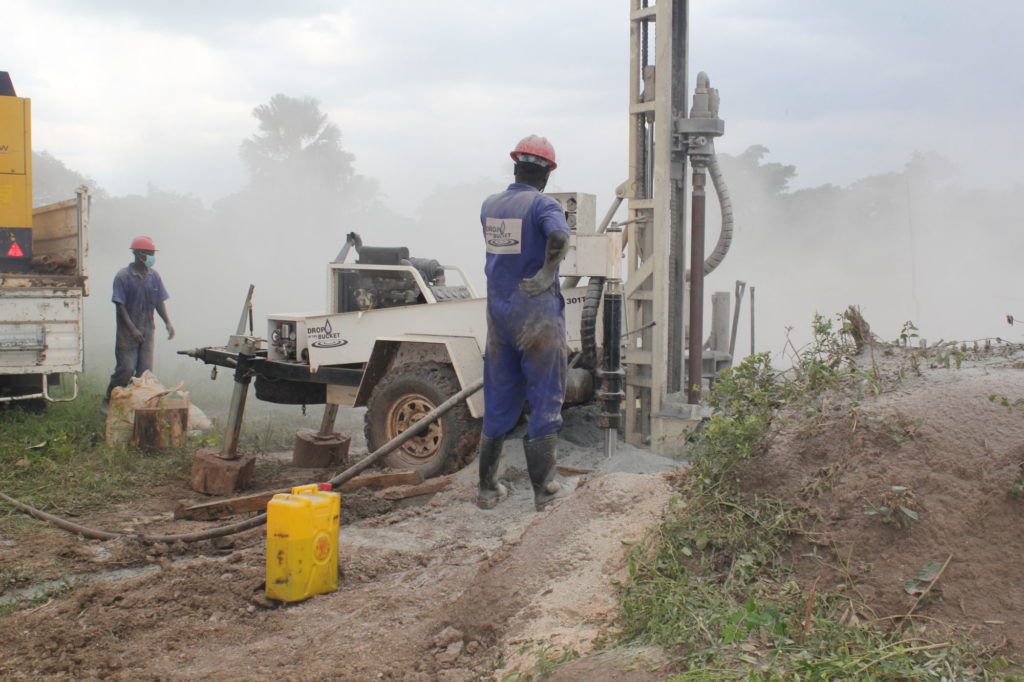
Many people think that because a country is water-stressed, there is no water, but in Uganda, where we work, productive aquifers typically sit 50–60 meters below the ground. This depth is far beyond the digging capability of most villagers. In most circumstances an aquifer tis dee can be accessed by a professionally drilled borehole fitted with a submersible pump. Drop in the Bucket owns and operates drilling equipment capable of reaching depths of up to 80 meters. We install several different types of pumps including roundabout pumps, solar powered pumps, diesel powered pumps and hand pumps. The hand pumps we use are India Mk II open source pumps. The reason we use these pumps is because they are the only hand pump approved by the Ugandan government, replacement parts are widely available and local mechanics know how to service them.
The climate in sub-Saharan Africa is particularly challenging. Dry seasons are long and hot, and usually cause seasonal streams and ponds to dry up and disappear. When the rains arrive, floodwater can wash sewage and animal waste into open waterholes. A properly sited deep borehole—cased and screened, finished with a sanitary concrete apron, drainage, and fencing—protects the source year-round and keeps contaminants out. It’s not glamorous work, but we believe that water is life and that clean water is the most important first step towards helping communities move themselves out of poverty.
A community’s health is directly related to access to clean water, sanitation, and improved hygiene. Diarrhea, typhoid, and parasitic infections keep children out of the classroom and adults away from work. At any point in time approximately half of the world’s hospital beds are filled with people suffering from water related illness. That is why Drop in the Bucket’s approach involves more than just drilling a well. We spend time working with the communities before we ever drill a well. We also work with the community on a program of hygiene and sanitation training that includes education on the importance of effective handwashing. On safe storage of the water, on the dangers of open-defecation and the importance of latrine use, and menstrual hygiene management—so clean water is matched with healthy habits.
Too many water projects fail not because there’s no more water, but because nobody knows how to fix the well pump when it has problems. If the community does not have access to trained hand pump mechanics or locally available replacement parts, or lacks the funding to pay for repairs as they come up. Drop in the Bucket’s program addresses all three of these factors. We train pump mechanics in every community where we drill a well. We show community stakeholders where to get replacement parts and we set up village savings and loan association (VSLA) groups that ensure that the water users always have the funds to cover repairs as needed. Sustainability isn’t an add-on; it’s the cornerstone of our drilling program.